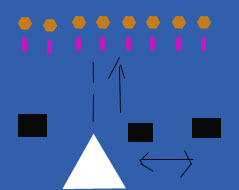
Dla prostej grafiki stary poczciwy OpenGL byłby w stanie takie coś narysować. Wiem, że teraz jest inny nowocześniejszy styl programowania w OGL z szaderami, ale stary nadal działa i będzie działać. Taki prosty przykład z wykorzystaniem SDL oraz OpenGL w trybie bezpośrednim.
Kopiuj
// g++ -o main main.cpp -std=c++20 -Wall -Wextra `sdl2-config --cflags --libs` -lOpenGL32 -lGLU32 -lm && ./main

#include <GL/gl.h>
#include <GL/glu.h>
#include <SDL2/SDL.h>

#include <cmath>
#include <iostream>
#include <numbers>

using std::numbers::pi;

struct vec2 { float x, y; };
struct vec3 { float x, y, z; };

const vec3 orange{0.8, 0.5, 0.0};
const vec3 light{0.8, 0.8, 0.8};
const vec3 dark{0.1, 0.1, 0.1};

constexpr int width  = 480;
constexpr int height = 320;

// functions declarations
void initGL();
void setOrigin(const vec3& position);
void drawTriangle(const vec2& v1, const vec2& v2, const vec2& v3, const vec3& color);
void drawQuad(const float width, const float height, const vec3& color);
void drawHexagon(const float radius, const vec3& color);

int main(int, char*[]) {
    SDL_Init(SDL_INIT_EVERYTHING);
    SDL_Window* ws = SDL_CreateWindow("gra", 50, 50, width, height, SDL_WINDOW_OPENGL);
    SDL_GLContext ctx = SDL_GL_CreateContext(ws);
    SDL_GL_MakeCurrent(ws, ctx);

    initGL();

    bool quit = false;
    for (;;) {
        // process events
        SDL_Event event;
        while (SDL_PollEvent(&event)) {
            if (((event.type == SDL_QUIT) || (event.type == SDL_KEYDOWN)) &&
                (event.key.keysym.sym == SDLK_ESCAPE)) {
                quit = true;
            }
        }
        if (quit) break;

        // clear screen
        glClear(GL_COLOR_BUFFER_BIT | GL_DEPTH_BUFFER_BIT);

        // draw section
        setOrigin({(width / 10.0)*1.5, height - 20, 0});
        for (int i = 0; i < 8; i++) {
            drawHexagon(10, orange);
            glTranslatef(width / 10, 0, 0);
        }

        setOrigin({width / 2, 20, 0});
        drawTriangle({0, 0}, {20, 0}, {10, 20}, light);

        setOrigin({40, 100, 0});
        drawQuad(100, 50, dark);

        // swap buffers
        SDL_GL_SwapWindow(ws);
    }

    SDL_GL_DeleteContext(ctx);
    SDL_DestroyWindow(ws);
    SDL_Quit();

    return 0;
}

void initGL() {
    glEnable(GL_DEPTH_TEST);
    glClearColor(0.3f, 0.3f, 0.5f, 1.0f);

    glMatrixMode(GL_PROJECTION);
    glLoadIdentity();
    gluOrtho2D(0, width, 0, height);

    glMatrixMode(GL_MODELVIEW);
}

void setOrigin(const vec3& position) {
    glLoadIdentity();
    glTranslatef(position.x, position.y, position.z);
}

void drawTriangle(const vec2& v1, const vec2& v2, const vec2& v3, const vec3& color) {
    glBegin(GL_TRIANGLES);
        glColor3fv(&color.x);
        glVertex2fv(&v1.x);
        glVertex2fv(&v2.x);
        glVertex2fv(&v3.x);
    glEnd();
}

void drawQuad(const float width, const float height, const vec3& color) {
    glBegin(GL_QUADS);
        glColor3fv(&color.x);
        glVertex2f(0, 0);
        glVertex2f(width, 0);
        glVertex2f(width, height);
        glVertex2f(0, height);
    glEnd();
}

void drawHexagon(const float radius, const vec3& color) {
    glBegin(GL_POLYGON);
        glColor3fv(&color.x);
        for (int i = 0; i < 6; ++i) {
            glVertex2f(radius * cos(i * 60 * pi / 180.0),
                       radius * sin(i * 60 * pi / 180.0));
        }
    glEnd();
}
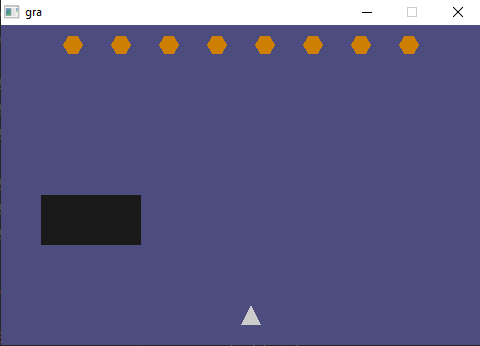
SDL jest tutaj do tworzenia okna i zainicjowania OpenGLa, ale dla grafiki tylko 2D to może się on bez niego obejść. Osobiście dla mnie OGL jest wygodniejszy i ma więcej możliwości dlatego wole z niego korzystać nawet do grafiki dwuwymiarowej.
Sprawdź też koniecznie SFML https://www.sfml-dev.org/ . Dość ciekawa biblioteka w funkcjonalności podobna do SDLa. W przeciwieństwie do SDL napisana w stylu obiektowym.